PeekaBoo Cam Chat - Click image to visit Site
Site Under Construction

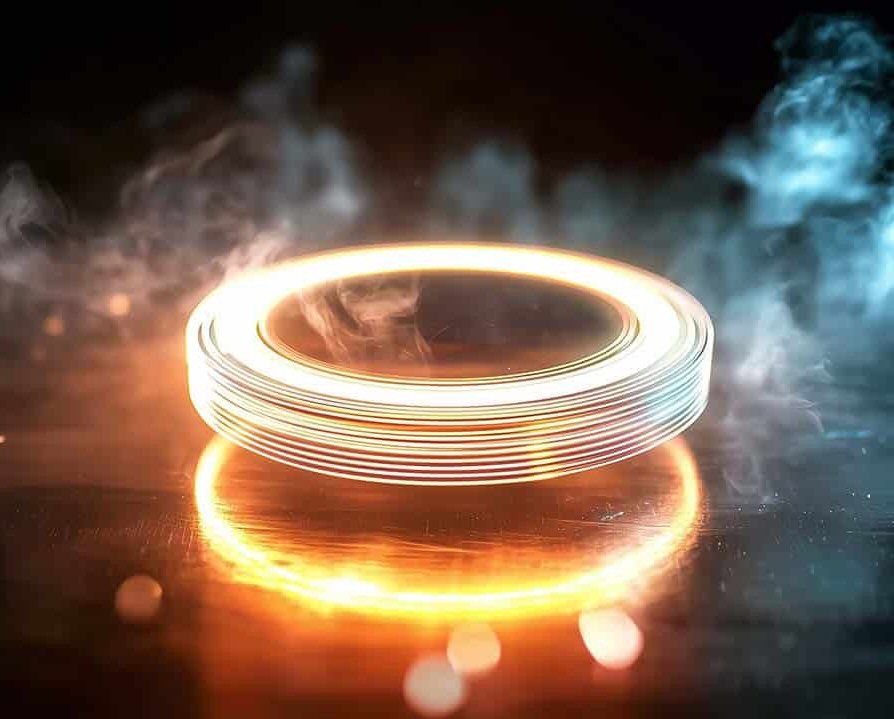
Eugene Podkletnov's Impulse Gravity Generator
Education and Background: Podkletnov was born in Russia 1954 and graduated from the University of Chemical Technology, Mendeleyev Institute, in Moscow; he then spent 15 years at the Institute for High Temperatures in the Russian Academy of Sciences. He received a doctorate in materials science from Tampere University of Technology in Finland. After graduation he continued superconductor research at the university, in the Materials Science department, until his expulsion in 1997. After which he moved back to Moscow where it is reported that he took an engineering job. Since leaving Tampere in 1997 Podkletnov has avoided public contact or appearances. There is a report that he later returned to Tampere to work on superconductors at Tamglass Engineering Oy
Eugene Podkletnov is known for his claims made in the 1990s of designing and demonstrating gravity shielding devices consisting of rotating discs constructed from ceramic superconducting materials. Podkletnov’s "gravity impulse" research transitioned from his earlier static weight-loss experiments into two distinct methods for actively generating focused, directional gravitational shockwaves using high-voltage discharges and superconducting ceramics
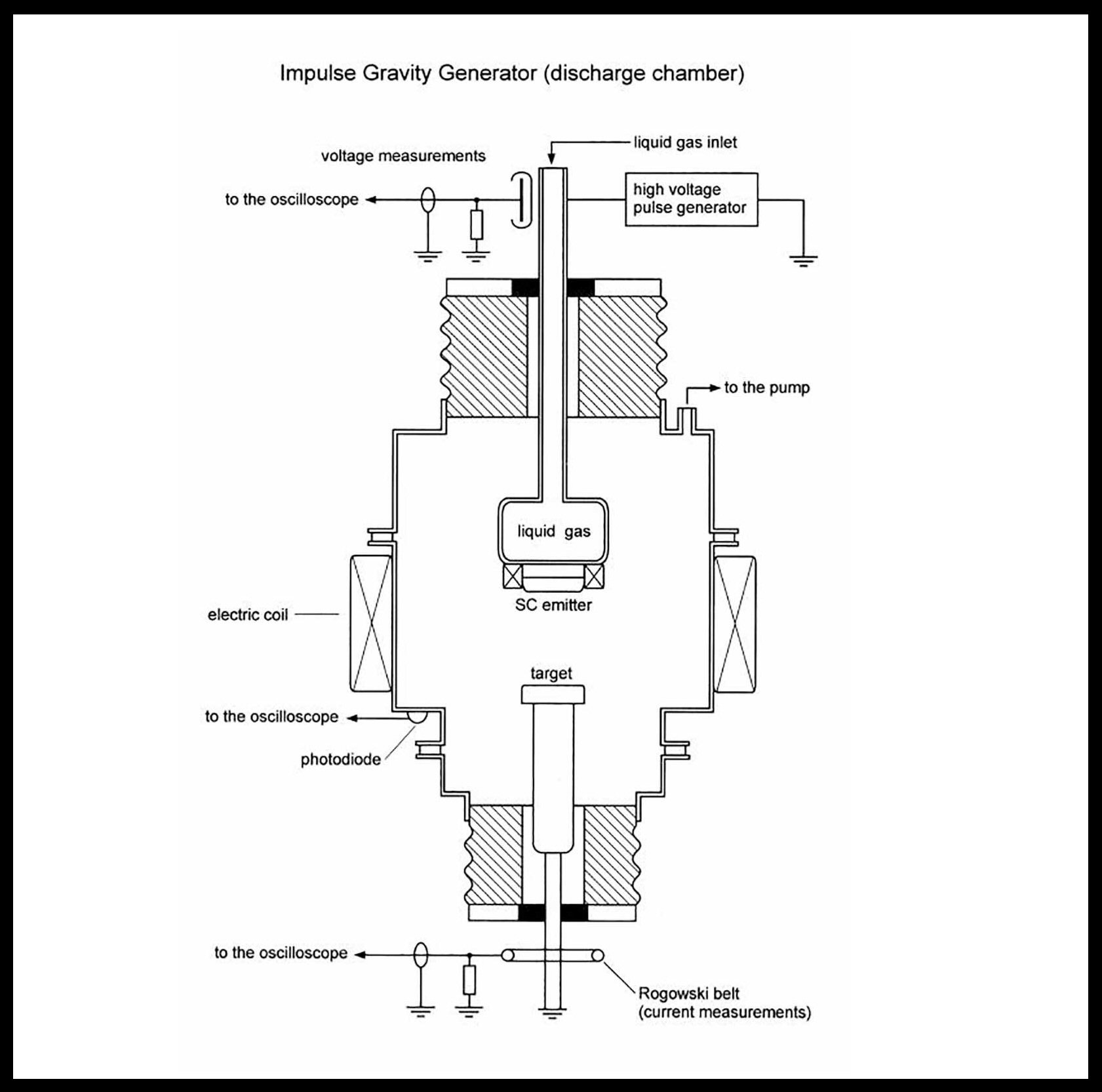
Podkletnov and Dr. Giovanni Modanese detailed these two primary setups for their Impulse Gravity Generator
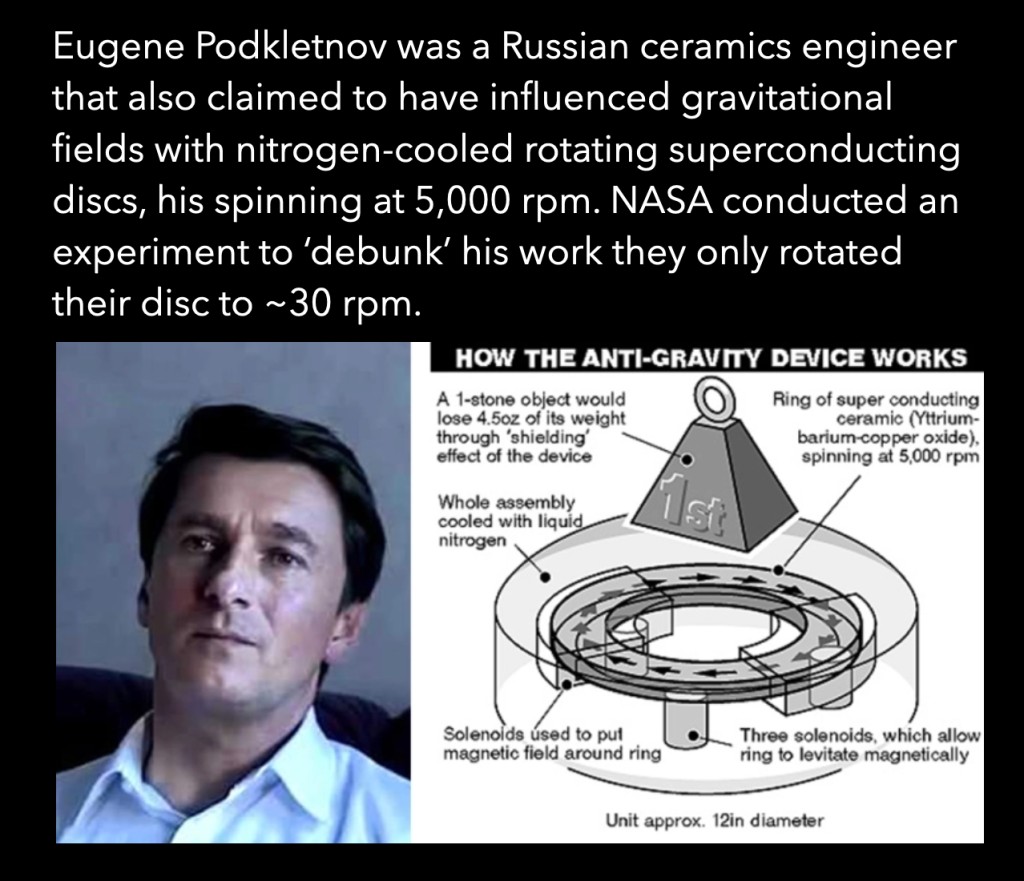
Experiment #1 - 1992: The Rotating Superconducting Disk: - This first device in which Podkletnov believed he had found a gravity-related effect begins with the Rotating Superconducting Disk Experiment. The apparatus belonged to the world of cryogenic materials science: a bulk YBa₂Cu₃O₇−x ceramic superconductor, cooled to low temperature, mounted in a magnetic setup, and driven to very high rotational speed. What made the device remarkable was the scale of force it seemed to alter. Instead of producing thrust or visible motion, it was said to produce a slight reduction in weight above the disk,
According to the account Podkletnov gave to Wired reporter Charles Platt in a 1996 phone interview, during the 1992 experiment with a rotating superconducting disc:
"Someone in the laboratory was smoking a pipe, and the pipe smoke rose in a column above the superconducting disc. So we placed a ball-shaped magnet above the disc, attached to a balance. The balance behaved strangely. We substituted a nonmagnetic material, silicon, and still the balance was very strange. We found that any object above the disc lost some of its weight, and we found that if we rotated the disc, the effect was increased."
Experiment #2: The Impulse Gravity Generator
Podkletnov reported that it was possible to forgo the spinning disk and instead rotate the magnetic fields, or apply high-voltage electrical discharges through a stationary superconducting emitter subjected to a strong trapped magnetic field. This setup produced focused, short-duration impulses of "gravity" that could travel through various materials without attenuation and exert sharp repulsive forces on distant objects. By subjecting the superconducting emitter to a 5 megavolt pulse of electrical energy, it is capable of punching holes in concrete & deforming inch-thick steel plates. The Gravity Impulse Beam passed through Walls and celings, in the same way that gravity is felt on each floor of a multistory building.
Podkletnov says this in 1997 - "Normally there are two spheres, and a spark jumps between them. Now imagine the spheres are flat surfaces, superconductors, one of them a coil or O-ring. Under specific conditions, applying resonating fields and composite superconducting coatings, we can organize the energy discharge in such a way that it goes through the center of the electrode, accompanied by gravitation phenomena - reflecting gravitational waves that spread through the walls and hit objects on the floors below, knocking them over...The second generation of flying machines will reflect gravity waves and will be small, light, and fast, like UFOs. I have achieved impulse reflection; now the task is to make it work continuously."
Podkletnov - Gravity Control Breakthrough 2025 !!
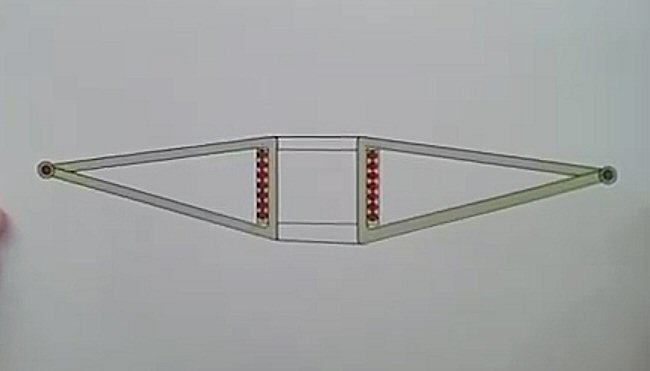
So Podkletnov is basically saying that a "Spinning Super Conducting Disk" is not needed at all and just the 2 stationary coils creates the Electro-Magnetic torsion gravity impulse effect
Ray Kurzweil - On Wikipedia - CLICK HERE : Dr Roman Yampolskiy - On Wikipedia - CLICK HERE
This is a Hi Res Image - If you are using
an ipad or Smart Phone, ZOOM in to read details !!
NVIDIA
Nvidia has become the dominant provider of Ai hardware and software, fueling the Ai revolution with its specialized GPUs, which power major data centers and tech companies. With a market valuation over $3 trillion, the company provides full-stack Ai solutions, including NIM microservices, NeMo frameworks, and data-center-scale infrastructure to accelerate generative Ai, robotics, and quantum computing efforts..
NVIDIA and Boston Dynamics
MSTP - Atlas 003 - CLICK HERE
Boston Dynamics is collaborating with NVIDIA to accelerate Ai capabilities in its electric Atlas humanoid robot using the NVIDIA Jetson Thor computing platform and Isaac Lab simulation framework. This partnership focuses on enhancing Ai-powered manipulation, mobility, and real-time inference, enabling robots to train in virtual environments before operating in industrial settings
3 ATLAS Video's - MAXIMIZE VIDEO DISPLAYS !!
IT BLOWS YOUR MIND and looks kinda CREEPY !!
In the Ai years to come - The future decendants of "ATLAS 003" will have it all !!
"ATLAS 003" Video - Performing in January 2025
Atlas Airborne, 08\01\2026 - the Final Evolution
VIDEO 1 - MARS - EARTH
We First Need to Know the Ai Jargon
Large Language Models (LLMs) - Are advanced Ai systems trained on massive datasets using transformer architecture to understand, summarize, generate, and predict text and code. They serve as the backbone for generative Ai, powering chatbots like ChatGPT, virtual assistants, and analytical tools for tasks like translation and document summarization.
Ai "Graphics Processing Unit" (GPU) - Is a specialized electronic circuit designed for high-speed, parallel processing, making it essential for Ai training and inference. Unlike CPUs that handle sequential tasks, GPUs use thousands of cores (Blackwell GPU = 2560 CUDA Cores) to calculate massive datasets simultaneously, accelerating deep learning, computer vision, and generative Ai workloads.
Foundational Ai Concepts
Artificial Intelligence (Ai): - Machines simulating human intelligence to think, learn, and act.
Artificial General Intelligence (AGI): - A hypothetical, future Ai that matches or exceeds human intelligence across all fields.
Machine Learning (ML): - A subset of Ai where machines learn from data without explicit programming.
Deep Learning: - A subset of ML using multi-layered neural networks to mimic the human brain.
Neural Networks: - Computer systems modeled on the human brain's network of neurons.
Generative Ai & LLMs
Generative Ai (GenAi): - Ai that creates new content, such as text, images, or music.
Large Language Model (LLM): - Ai designed to generate human-like text based on massive datasets.Transformer: - A neural network architecture that understands context by analyzing relationships in data, essential for modern LLMs.
Prompt: - The input (text, image, or code) provided by a user to guide the Ai to generate a specific output.
Hallucination: - When a generative Ai model produces false, irrelevant, or illogical information.
Multimodal Ai: - Ai capable of processing and understanding multiple types of input (text, images, audio, video).
Diffusion Models: - A type of generative model often used to create images.
Technical & Methodological Terms
Algorithm: - A set of instructions or rules followed by a computer to learn from data or perform a task.
Training Data: - The information used to teach ML models to recognize patterns and make predictions.
Supervised Learning: - Training a model on labeled data (input and known output).
Unsupervised Learning: - Training a model on unlabeled data to find hidden patterns or structures.
Reinforcement Learning (RL): - A training method where the Ai learns by trial-and-error to achieve a goal, receiving rewards or penalties.
Backpropagation: - A method used in training neural networks to adjust weights and reduce errors
The history of Artificial Intelligence: - Is characterized by cycles of high optimism ("Ai summers") followed by periods of intense disillusionment and funding cuts ("Ai winters"). The "slowdown" in the 1970s and 1980s was not a complete stop in research, but rather two distinct "AI winters" (1974–1980 and late 1980s–early 1990s) caused by the failure of early Ai to meet its own exaggerated promises due to limited computer power leading to a loss of investor and government confidence. Look at the first chart below, you can see the slump between 1974-90.
Exponential Price-Performance
Chart 1: 1939-2023 - The price-performance of computation, often measured as computations per second per constant dollar, has experienced an exponential increase over the past century, with a 20 quadrillion-fold increase between 1931 and early 2024. This dramatic trend indicates that computing power per dollar doubles every two years for Ai-specific GPUs and roughly every 2.5 years for general GPUs, a phenomenon sometimes described as "price-performance Moore’s Law"
Chart 2: 2006-2020 - In 2006, GPU computational performance per dollar began a significant upward trend, with FLOP/s per dollar roughly doubling exponentialy every 2.5 to 3 years thereafter. While 2006 was the dawn of GPGPU with NVIDIA's CUDA, early performance-per-dollar was low compared to later years, but represented a massive, early leap over CPU capabilities for specialized tasks
AliveMoment.com Ai uses automatic Rigging & Mapping: - The Ai uses sophisticated algorithms to achive complex and totally convincing renderings, but basicly It utilizes automated 2D to 3D rigging techniques to establish a "skeleton" for the subject, enabling the Ai to move components like hair, clothing, or limbs while maintaining the context of the original scene.
I have made 25 AM video's, and each time it blows my mind, as almost every time the Ai has so little to go on from the still photo. This is 1) of Mum in 1953 aged 17, and 2) Chris - Tina - and me Mick, living in the post-war prefabs in 1967. The video's are only 10 seconds long, and i wish they could be 20 seconds as i think that would be ideal !!.
Mum in 1953 aged 17
Chris - Tina - Mick - 1967
You are Visitor
Since 18/05/2025
Please visit again
Free Hit Counter supplied from www.hitwebcounter.com - CLICK HERE
IN-AP Systems - Established 1997

A computer is like the mind, it has IN-finite AP-plications...