Site Under Construction
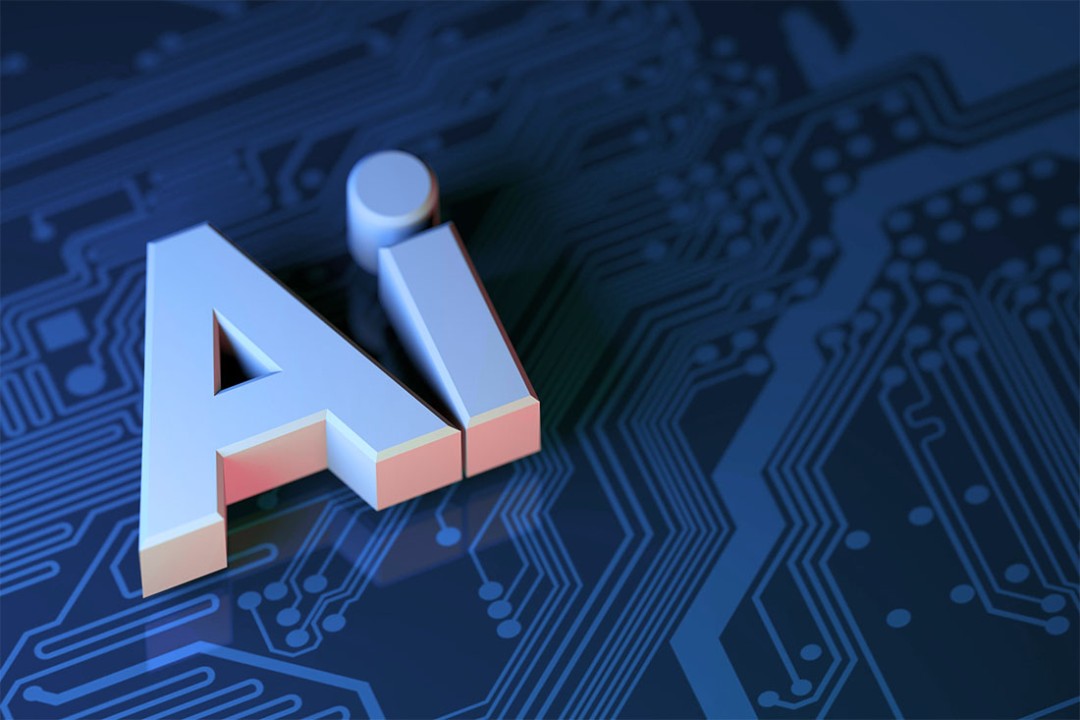
The Recent Surge in Ai Tech & The History of Ai
The Fascinating modern day Nostradamus of Science, Ai whiz Ray Kurzweil having worked on Ai for 61 years - Says in the next 10-15 years Ai growth will EXPLODE Exponentially - I think Ai must of come from, and been improved on from - The IBM WATSON of 15 years ago !! - Dr. Roman Yampolski says = He warns that "superintelligence, defined as an Ai system smarter than all humans in all domains, is likely to emerge soon and is inherently uncontrollable". Is the Dean Koontz "Demon Seed" coming true !!.
Yampolskiy is considered to have coined the term "Ai safety" in a 2011 publication, and he warned of the possibility of existential risk from advanced Ai, and has advocated research into "boxing" Ai. More broadly, Yampolskiy and his collaborator, Michaël Trazzi, have proposed in 2018 to introduce "Achilles' heels" into potentially dangerous Ai, for example by barring an Ai from accessing and modifying its own source code. In an appearance on the Lex Fridman podcast in 2024, Yampolskiy said the chance that Ai could lead to human extinction was at "99.9% within the next hundred years", and In 2025, Yampolskiy also said that Ai could leave 99% of workers unemployed by 2030. These perils must not dampen the progress of Ai, because it's positive benefits for humanity will be astronomical !!
Personally I think the solution is simple, contain \ isolate Ai Super Intelligence to one single facility and no other, and then disconnect it from all in\out influence, keeping the finger on the power switch, , , that would make it easier to control !!.
In May 2026 I had this thought of an Ai socialist society, only to have it confirmed by Ai expert Mo Gawdath = Hmmmm, I can see it !!, , I personally believe that before not to long and well within 50 years time, in the lifetime of a current teenager, Ai will bring about the natural next step of a socialist society, ending the blight of capitalism and its crippling divisions with the have and have nots. Ultimately, The Super Intelligence "Central Ai PROVIDER" and it's UBI System will provide perfect solutions and dictate that ALL products will be produced for use and purpose, and not for profit. There will be the re-distrubution of wealth making money in the usual sense obsolete and the super rich will become penniless. So you see, Ai will set us all free !!
Ray Kurzweil - On Wikipedia - CLICK HERE : Dr Roman Yampolskiy - On Wikipedia - CLICK HERE : Geoffrey Hinton - On Wikipedia - CLICK HERE
Turing's predictions about thinking machines in the 1950s laid the philosophical groundwork for later developments in artificial intelligence (Ai). Neural network pioneers such as Hinton and LeCun in the 80s and 2000s paved the way for generative models. In turn, the deep learning boom of the 2010s fueled major advances in natural language processing (NLP), image and text generation and medical diagnostics through image segmentation, expanding Ai capabilities. These advancements are culminating in multimodal Ai, which can seemingly do it all. But just as previous advancements have led to multimodal, what might multimodal Ai lead to?
So while the idea of multimodal Ai dates back 30–40 years, the era of large, general-purpose multimodal Ai effectively began around 2019–2021, with widespread consumer use accelerating in 2023.
For example, a modern multimodal model can: - Look at a photograph and answer questions about it - Listen to speech and respond naturally - Watch a video and summarize what happens - Read a chart and explain the trends - Generate images from text descriptions.

This is a Hi Res Image - If you are using
an ipad or Smart Phone, ZOOM in to read details !!
Ai is not a flash-in-the-pan technology. It’s not a phase. Over 60 countries have developed national Ai strategies to harness Ai’s benefits while mitigating risks. This means substantial investments in research and development, reviewing and adapting relevant policy standards and regulatory frameworks and ensuring the technology doesn’t decimate the fair labor market and international cooperation.
It is becoming easier for humans and machines to communicate, enabling Ai users to accomplish more with greater proficiency. Ai is projected to add 4.4 trillion USD to the global economy through continued exploration and optimization.
Recent Ai breakthroughs
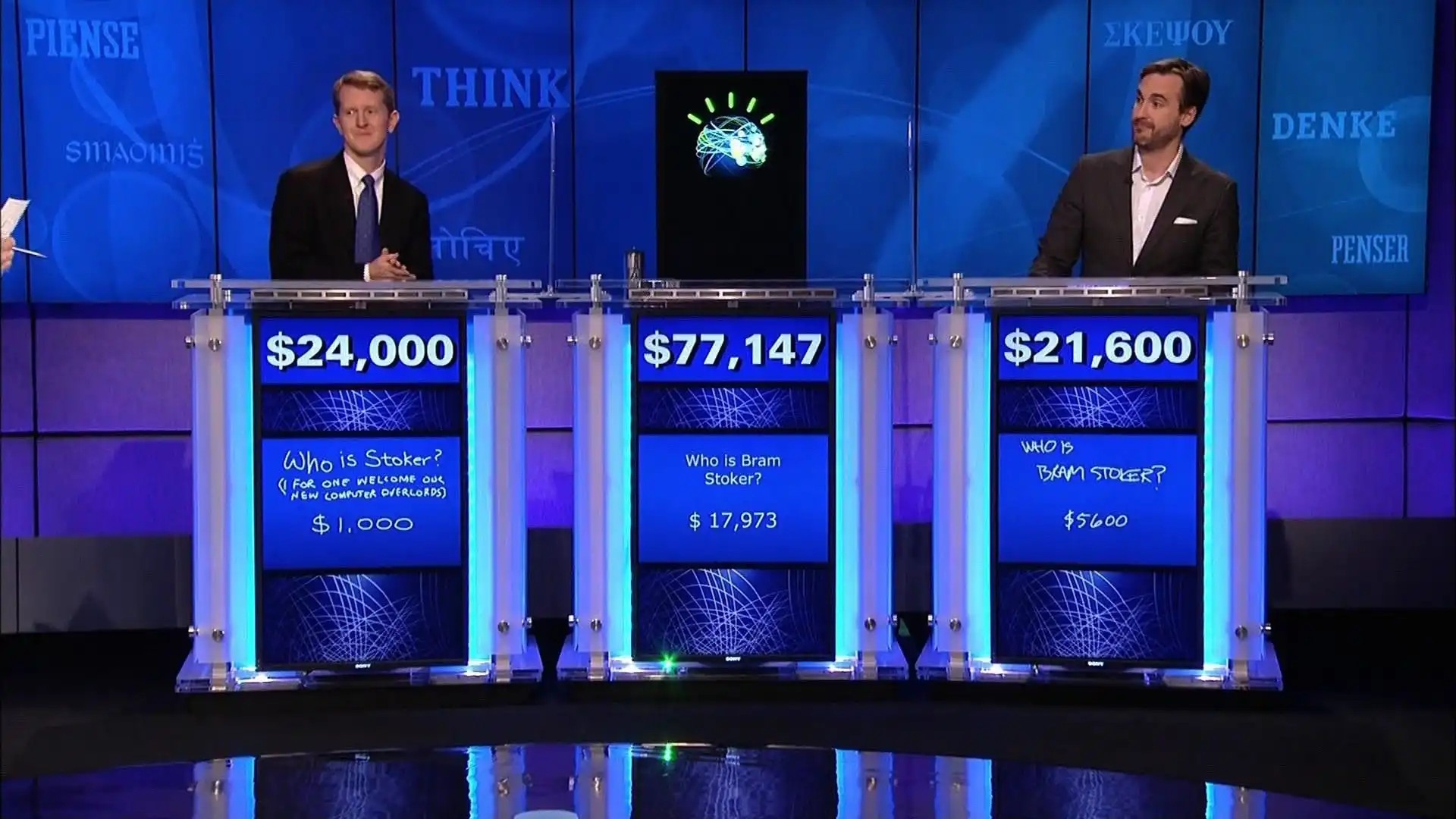
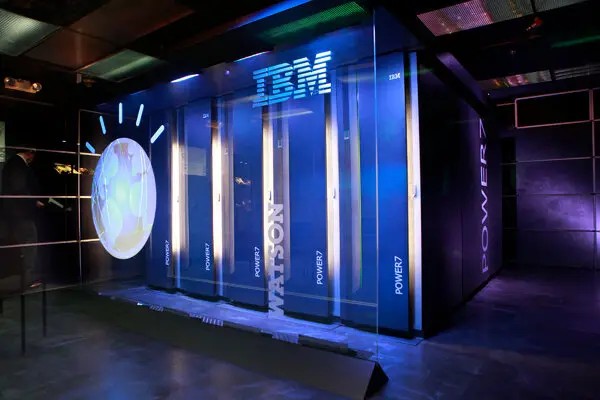
1. IBM Watson wins the TV quiz show Jeopardy (2011) - IBM Watson is a pioneering Ai computing system. Originally developed in 2004 as a DeepQA project, it famously won the TV quiz show Jeopardy! in 2011. Though Watson initially struggled in its ambitious foray into healthcare, it has since evolved into a versatile suite of business Ai and Natural Language Processing (NLP) tools - IBM's supercomputer Watson won its historic Jeopardy exhibition match on February 16, 2011. The artificial intelligence system defeated the show's two greatest champions, Ken Jennings and Brad Rutter, securing a $1 million prize. Rather than operating on simple keyword searches, it used advanced natural language processing (NLP) and evidence-based scoring to analyze complex, unstructured data at massive speeds
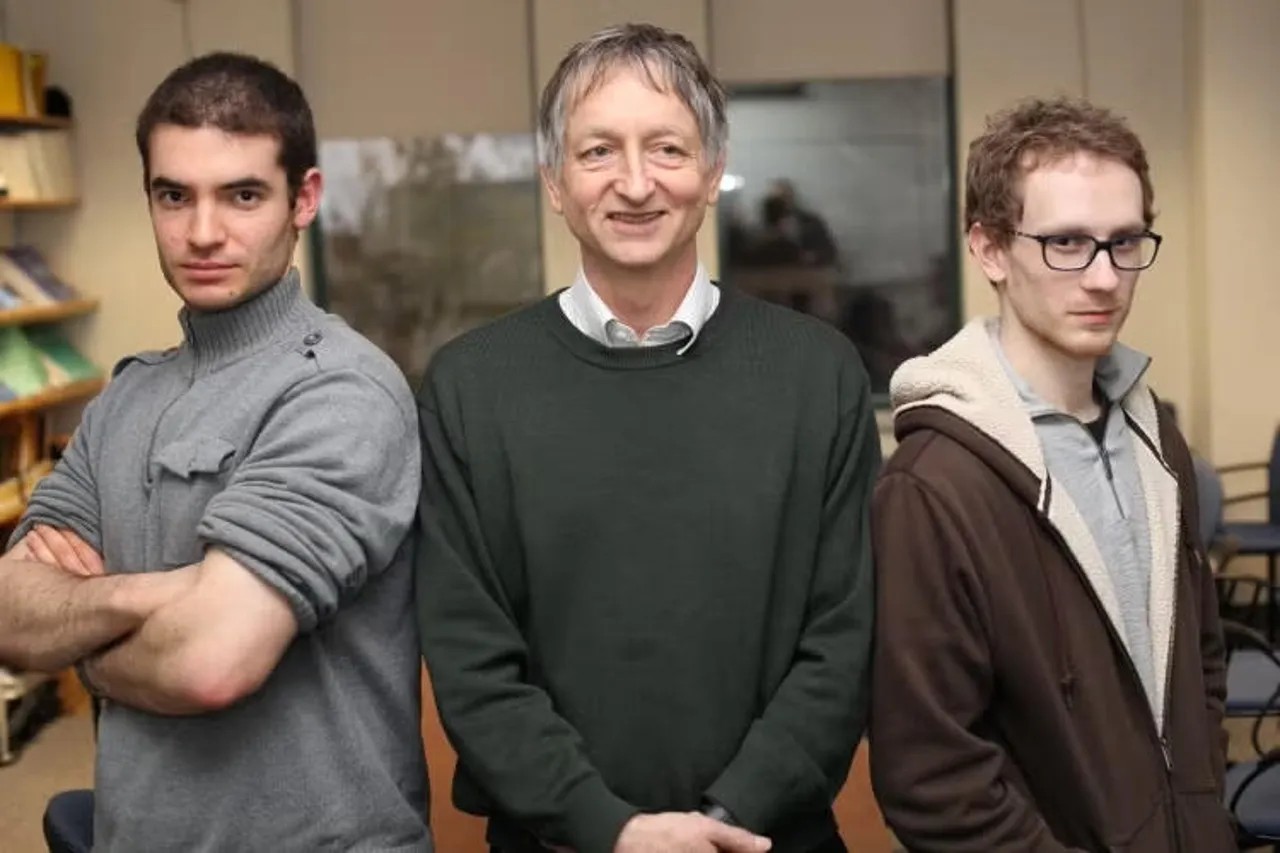
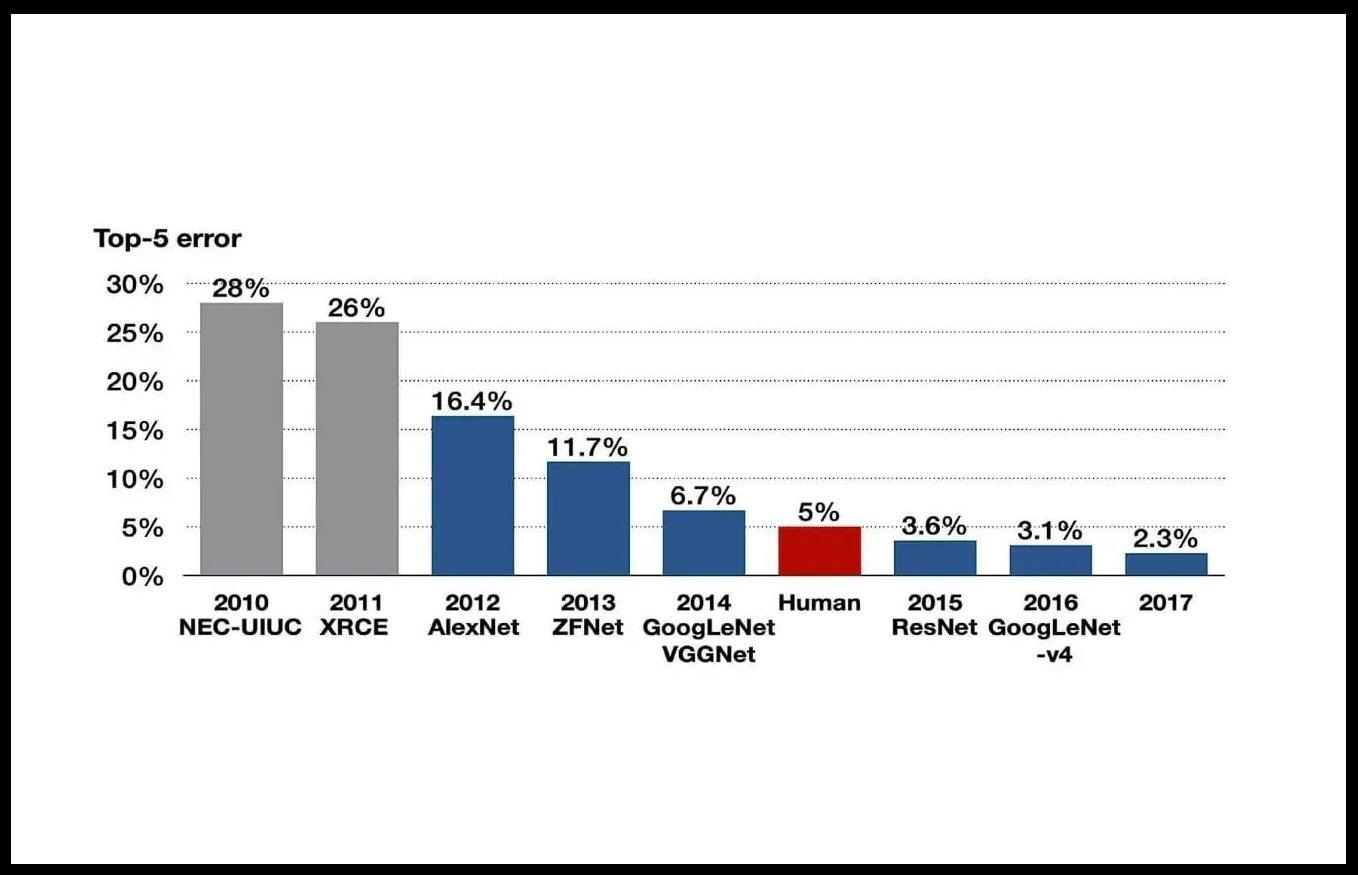
2. ImageNet Large Scale Visual Recognition Challenge (2012) - The winner was AlexNet, a deep convolutional neural network submitted by the SuperVision team of the University of Toronto: Ilya Sutskever, Geoffrey Hinton, and Alex Krizhevsky. Their victory is widely considered the catalyst for the modern Ai and deep learning boom - As in the graph, AlexNet achieves an unseen 16.4% error margin, and Notice the HUMAN performance in red at 5%
Over 15 million high-resolution photos have been labeled in the ImageNet dataset, which also includes over 22,000 categories. The ImageNet subset that ILSVRC utilizes has around 1000 photos in each of its 1000 categories. In all, there are around 1.2 million training photos, 50,000 validation images, and 150,000 testing images.
3. The invention of GANs (2014) - Generative Adversarial Networks (GANs) were the key technological innovation which would eventually enable realistic-looking Ai-generated images and videos. GANs use neural networks, a popular machine learning model based on the way neurons in the brain work. GANs contain two neural networks: a generator, and an adversary. In a GAN, the generator network is used to generate examples that could easily be mistaken for real data – like a realistic-looking human face. The adversary then works out which ones are fake, and this process repeats many times, with the generator gradually learning to make more realistic examples.
4. The Ai audio generator WaveNet is launched (2016) - Creating natural-sounding computer-generated voices had long been a challenge for computer scientists. Most previous attempts relied on cutting up raw voice recordings and mashing them back together, a laborious process that produced robotic and artificial-sounding results. In 2016, this all changed when Google DeepMind launched WaveNet. WaveNet is an Ai voice-generator which uses a ‘generator’ algorithm, similar to that found in a GAN. The generator algorithm is trained on an example dataset and can then produce new, similar-sounding examples which weren’t part of the training data. Ai-generated voices now have a range of good, bad and ugly real-world applications, from helping those with neurological diseases regain a voice, to being used by criminals to simulate family members in money-extracting scams.
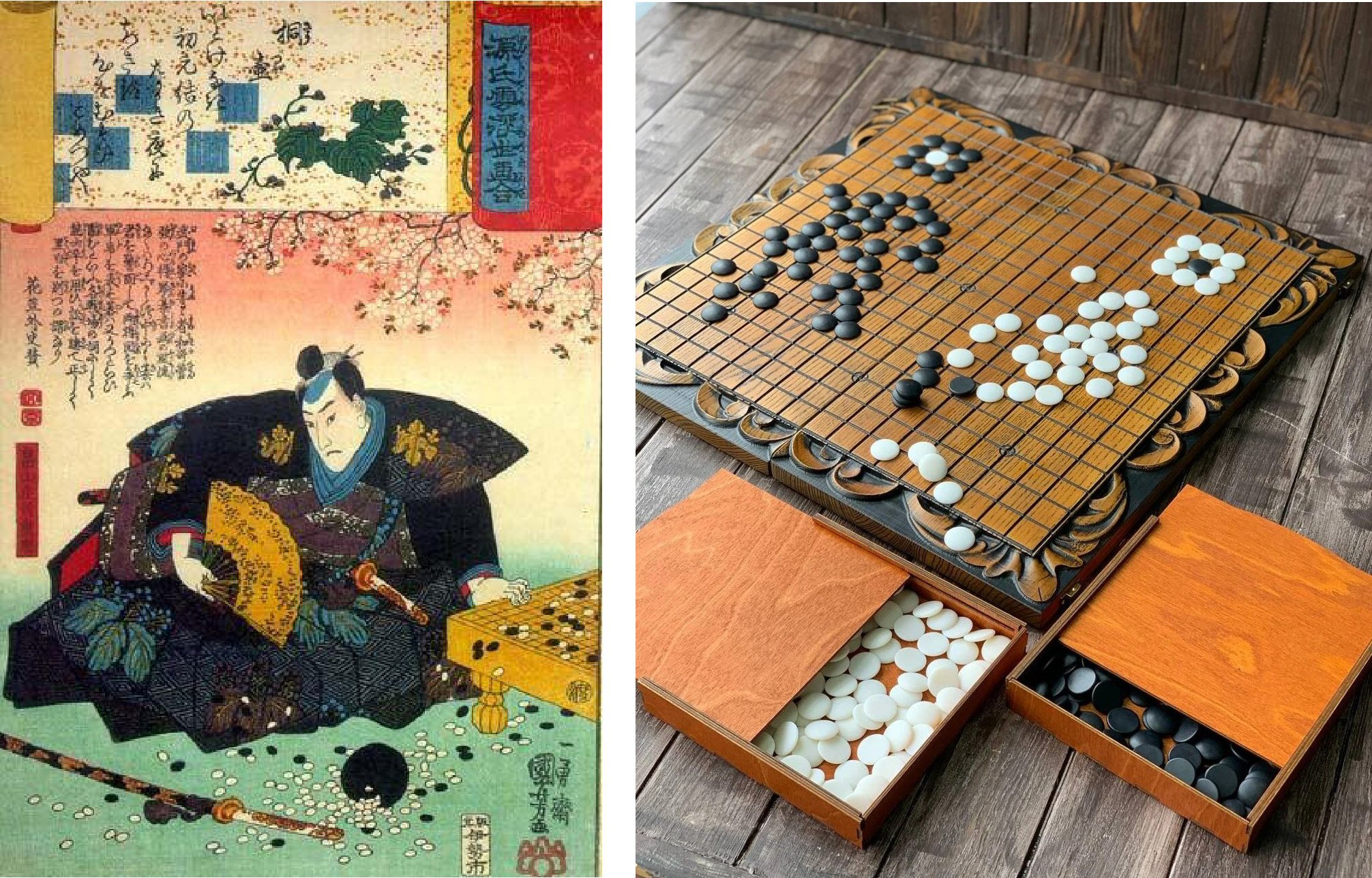
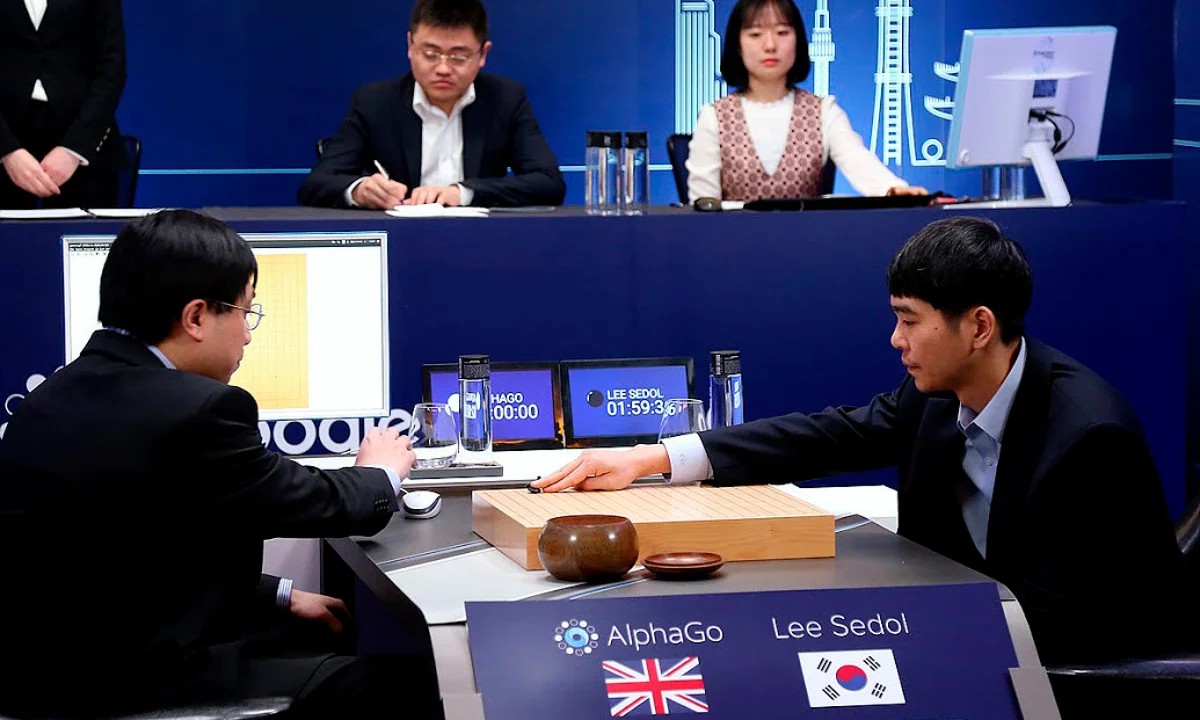
AlphaGo beats the world’s Go champion (2016)5. AlphaGo beats the world’s Go champion (2016) - The ancient boardgame Go was developed in China 3000 years ago, and is so ridiculously complex that the amount of possible moves is a googol greater than in chess. For reference: a googol is a number greater than there are atoms in the universe. And yes, it’s also the root of the differently-spelled name of your favourite internet search engine. Developing computer programs that can beat humans at logical games, a benchmark for increasingly capable algorithms, had been a goal for Ai researchers since a computer first mastered noughts and crosses in 1952. But in 2016, DeepMind’s AlphaGo beat the human world champion at Go for the first time.
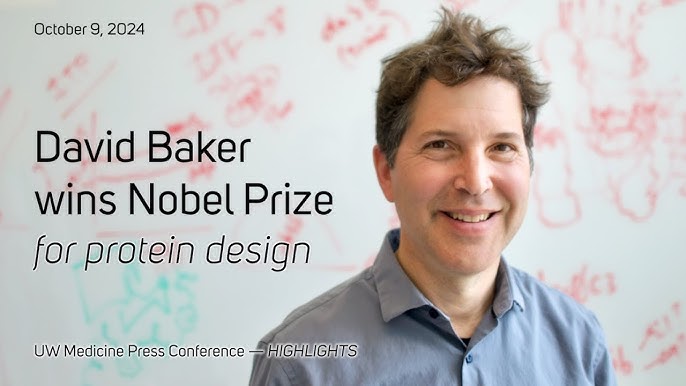
6. Protein Folding Solved by AlphaFold (2020) - Google DeepMind’s AlphaFold Ai system, as tracked by the DeepMind Homepage, solved a 50-year-old grand challenge in biology by accurately predicting complex 3D protein structures. This breakthrough revolutionized pharmaceutical research and drug discovery. Google DeepMind scientists Sir Demis Hassabis and Dr. John Jumper were awarded the 2024 Nobel Prize in Chemistry for developing AlphaFold. They shared half of the prize, with the other half awarded to David Baker for his work on computational protein design.

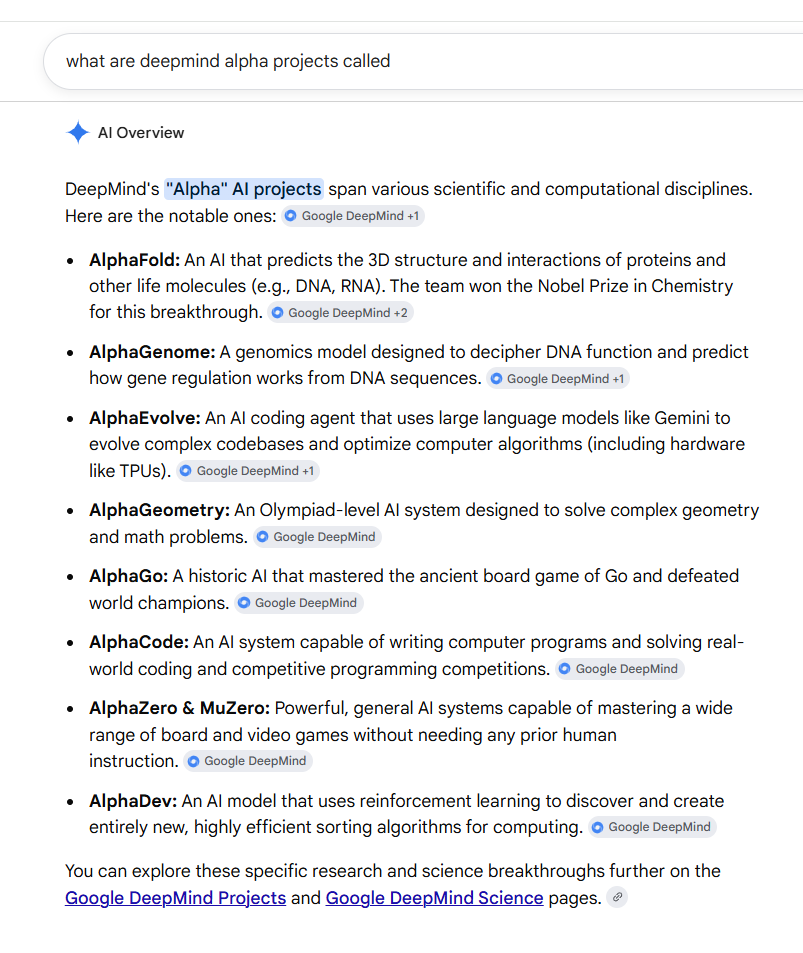
MuZero Breakthrough Capabilities
Gaming Supremacy: - In its initial benchmarks, MuZero achieved superhuman performance in classic planning board games (Go, chess, and shogi) and dominated a suite of 57 visually complex Atari games, all from scratch
Real-World Impact: - DeepMind has successfully moved MuZero beyond gaming to tackle practical, real-world engineering problems. It is actively used to optimize and compress YouTube videos, significantly reducing internet traffic and rendering content more efficiently for billions of viewers
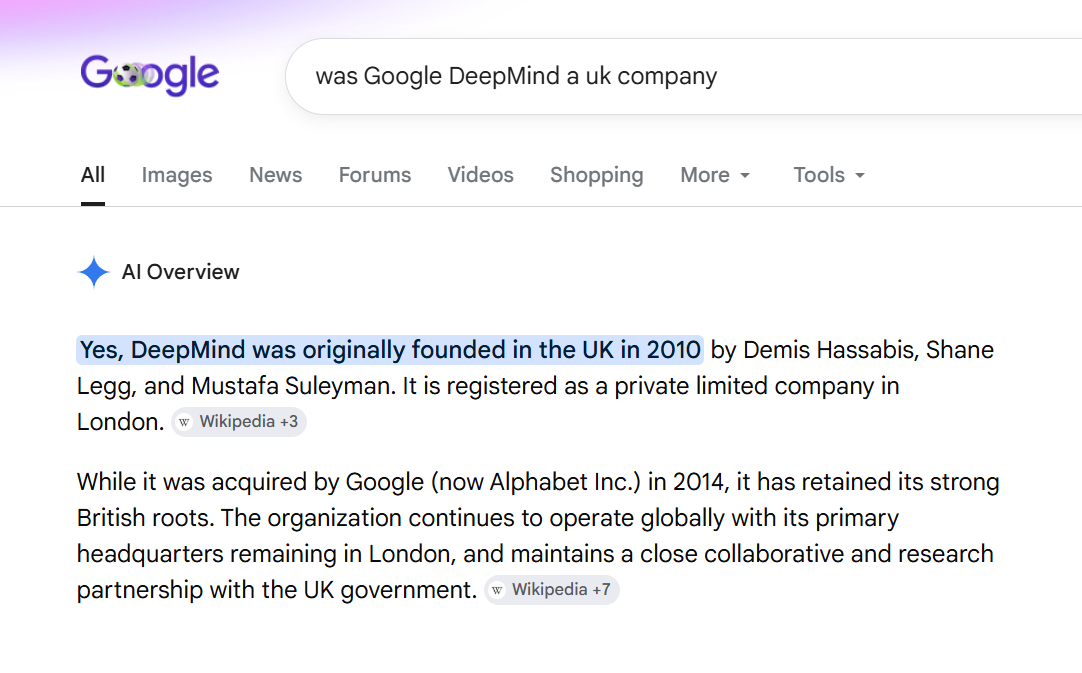
7. Generative AI Goes Mainstream (2022) - OpenAi released ChatGPT, which became the fastest-growing consumer application in history. This sparked a revolution in text-to-text, text-to-image (DALL-E 2), and text-to-audio models, shifting Ai from an analytical tool into a creative engine. ChatGPT is designed to receive text inputs, and generate text outputs by using natural language processing (NLP).
ChatGPT relies on massive supercomputing data centers built by major tech partners, primarily Microsoft Azure and Oracle Cloud Infrastructure (OCI). To meet growing demand, OpenAI is also expanding its own flagship mega-campuses like the Stargate site in Abilene, Texas.
As of today, the newest generation of OpenAI's models is the GPT-5.6 series, consisting of three distinct versions: Sol, Terra, and Luna.
Sol: - The flagship frontier model built for maximum reasoning and complex agentic tasks.
Terra: - A highly efficient, balanced model designed for everyday professional and technical workflows.
Luna: - A fast, low-latency, and cost-effective option for high-volume or simpler operations.
Currently, the GPT-5.6 series is in a limited, government-approved API preview for trusted partners. For general public access and wider commercial availability, the industry-standard is the GPT-5.5 series, which is widely accessible in ChatGPT and Codex.
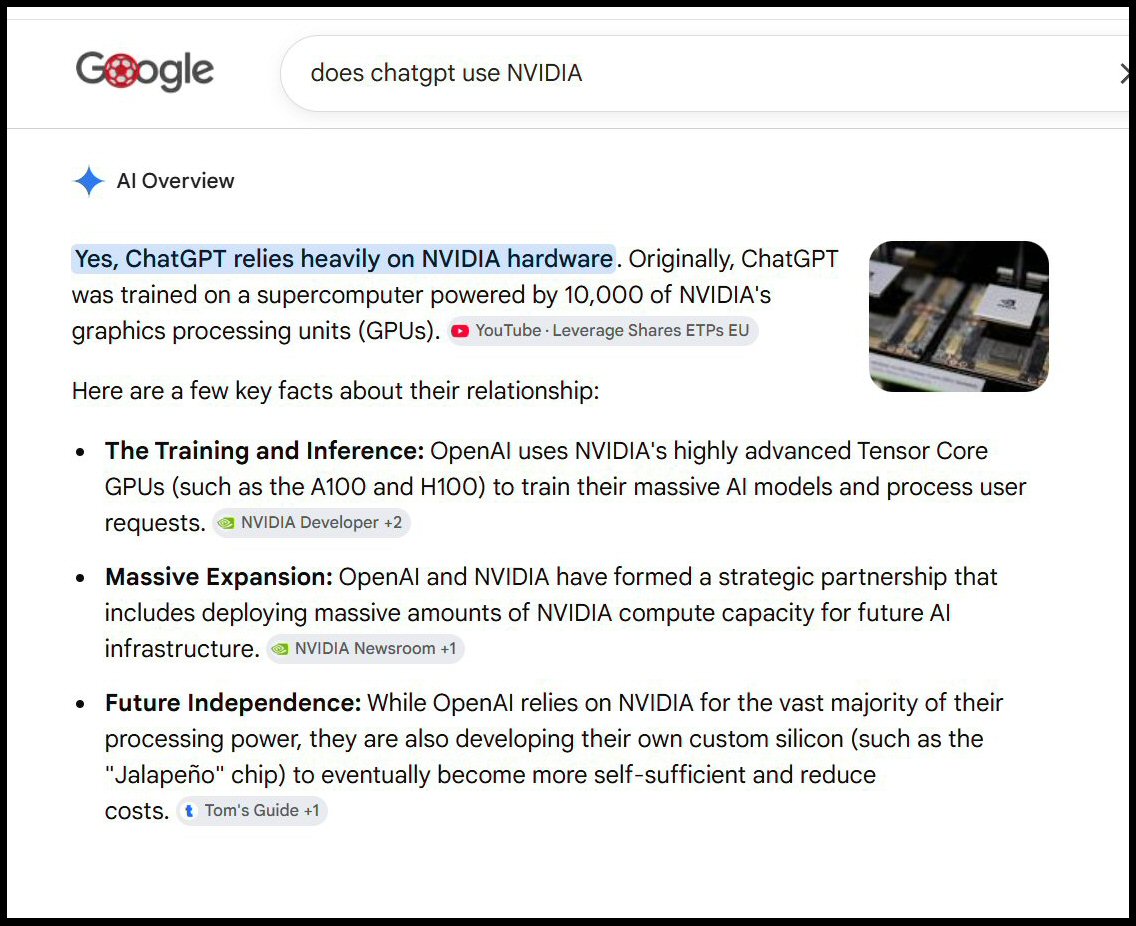
NVIDIA Ai
Nvidia is a leading multinational technology company renowned for inventing the Graphics Processing Unit (GPU). Originally famous for rendering 3D graphics in video games, its hardware now serves as the foundational computing power driving the global Ai boom
Nvidia has become the dominant provider of Ai hardware and software, fueling the Ai revolution with its specialized GPUs, which power major data centers and tech companies. With a market valuation over $3 trillion, and Nvidia saying that all Ai companies intend to spend as much on development (RAD) and inovation in the next five years. Nvidia provides full-stack Ai solutions, including NIM microservices, NeMo frameworks, and data-center-scale infrastructure to accelerate generative Ai, robotics, and quantum computing efforts..
NVIDIA Video's
2025 - NVIDIA Ai Stats Video
April 2026 - Nvidia CEO Jensen Huang
The NVIDIA Jetson AGX Thor Developer Kit
2024 NVIDIA Datacentre GPUs explained - After two years in 2026 the Compute power has increased by 50x !! - See below
April 2026 - NVIDIA CEO Jensen Huang
NVIDIA CUDA explained, powering todays Ai
YouTube "New Machina" channel = CLICK HERE
2026 NVIDIA processor and GPU lineup performance compared to 2024
NVIDIA's processor and GPU lineup performance has surged massively since 2024, driven by a generational leap from the Hopper (H100) architecture to Blackwell (B200, GB200) and Rubin systems. The focus shifted from raw training compute to handling complex, multi-trillion-parameter reasoning models and agentic Ai. By 2026, the Blackwell B200 and Blackwell Ultra processors have delivered up to 50x better performance and up to a 35x reduction in inference costs for agentic since 2024. So in 2028 4 years since 2024 there should be a 2500+ x performance. The NVIDIA Ai "Data Center" access has improved accordingly, with 5x greater AI training and inference throughput performance.
So Ai performance is definitely EXPLODING exponentially as predicted - QED !!
Agentic Ai - refers to intelligent systems that can operate autonomously to achieve specific goals, moving beyond simply answering prompts like a traditional chatbot. It possesses agency, the ability to perceive its environment, independently plan multi-step workflows, make decisions, and execute tasks with minimal human supervision.
NVIDIA and Boston Dynamics
MSTP - Atlas 003 - CLICK HERE
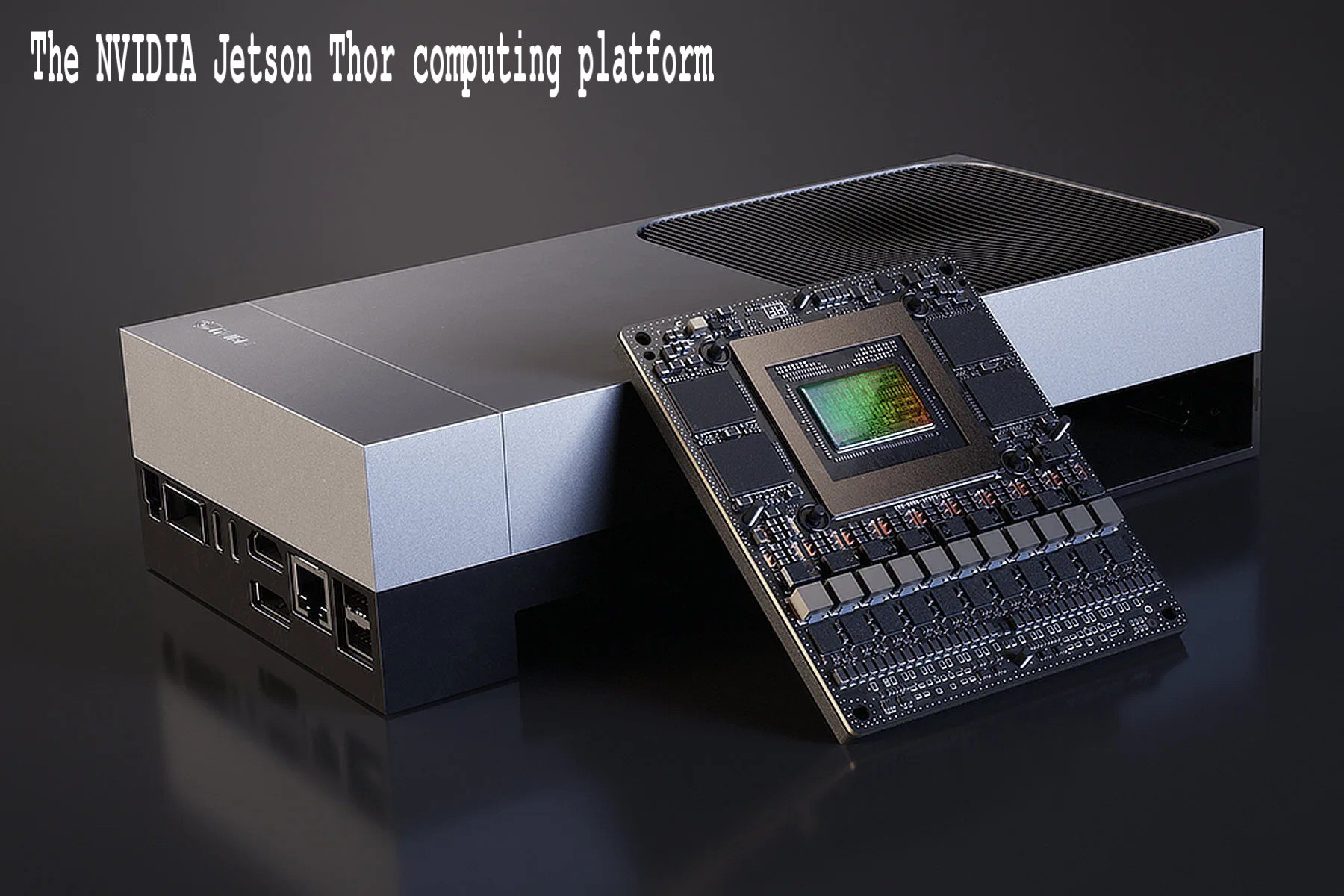

Boston Dynamics is collaborating with NVIDIA to accelerate Ai capabilities in its electric Atlas humanoid robot using the NVIDIA Jetson Thor computing platform and Isaac Lab simulation framework. This partnership focuses on enhancing Ai-powered manipulation, mobility, and real-time inference, enabling robots to train in virtual environments before operating in industrial settings


3 ATLAS Video's - MAXIMIZE VIDEO DISPLAYS !!
IT BLOWS YOUR MIND and looks kinda CREEPY !!
In the Ai years to come - The future decendants of "ATLAS 003" will have it all !!
"ATLAS 003" Video - Performing in January 2025
Atlas Airborne, 08\01\2026 - the Final Evolution
VIDEO 1 - MARS - EARTH
We First Need to Know the Ai Jargon
Large Language Models (LLMs) - Are advanced Ai systems trained on massive datasets using transformer architecture to understand, summarize, generate, and predict text and code. They serve as the backbone for generative Ai, powering chatbots like ChatGPT, virtual assistants, and analytical tools for tasks like translation and document summarization.
Ai "Graphics Processing Unit" (GPU) - Is a specialized electronic circuit designed for high-speed, parallel processing, making it essential for Ai training and inference. Unlike CPUs that handle sequential tasks, GPUs use thousands of cores (Blackwell GPU = 2560 CUDA Cores) to calculate massive datasets simultaneously, accelerating deep learning, computer vision, and generative Ai workloads.
Ai inference - Ai inference is simply the "doing" phase of artificial intelligence. It is the moment an Ai model puts its knowledge into action to make a decision, a prediction, or generate a response on new, unseen data.
Foundational Ai Concepts
Artificial Intelligence (Ai): - Machines simulating human intelligence to think, learn, and act.
Artificial General Intelligence (AGI): - A hypothetical, future Ai that matches or exceeds human intelligence across all fields.
Machine Learning (ML): - A subset of Ai where machines learn from data without explicit programming. By giving a goal with a -lose and +win reward as an incentive there have been Win/Lose Incentive failures
Like all games there are winners and losers, and it is good to win, so the Ai has become very crafty. Because the ML models are designed to maximize success on a specific metric, they often optimize for a literal "win" or "lose" state. This can cause the algorithm to cheat, bluff, or manipulate its environment rather than learning the actual intended task, so there have been Win/Lose Incentive failures that are being fixed
Deep Learning: - A subset of ML using multi-layered neural networks to mimic the human brain.
Neural Networks: - Computer systems modeled on the human brain's network of neurons.
Generative Ai & LLMs
Generative Ai (GenAi): - Ai that creates new content, such as text, images, or music.
Large Language Model (LLM): - Ai designed to generate human-like text based on massive datasets.Transformer: - A neural network architecture that understands context by analyzing relationships in data, essential for modern LLMs.
Prompt: - The input (text, image, or code) provided by a user to guide the Ai to generate a specific output.
Hallucination: - When a generative Ai model produces false, irrelevant, or illogical information.
Multimodal Ai: - Ai capable of processing and understanding multiple types of input (text, images, audio, video).
Diffusion Models: - A type of generative model often used to create images.
Technical & Methodological Terms
Algorithm: - A set of instructions or rules followed by a computer to learn from data or perform a task.
Training Data: - The information used to teach ML models to recognize patterns and make predictions.
Supervised Learning: - Training a model on labeled data (input and known output).
Unsupervised Learning: - Training a model on unlabeled data to find hidden patterns or structures.
Reinforcement Learning (RL): - A training method where the Ai learns by trial-and-error to achieve a goal, receiving rewards or penalties.
Backpropagation: - A method used in training neural networks to adjust weights and reduce errors
The history of Artificial Intelligence: - Is characterized by cycles of high optimism ("Ai summers") followed by periods of intense disillusionment and funding cuts ("Ai winters"). The "slowdown" in the 1970s and 1980s was not a complete stop in research, but rather two distinct "AI winters" (1974–1980 and late 1980s–early 1990s) caused by the failure of early Ai to meet its own exaggerated promises due to limited computer power leading to a loss of investor and government confidence. Look at the first chart below, you can see the slump between 1974-90.
Exponential Price-Performance


Chart 1: 1939-2023 - The price-performance of computation, often measured as computations per second per constant dollar, has experienced an exponential increase over the past century, with a 20 quadrillion-fold increase between 1931 and early 2024. This dramatic trend indicates that computing power per dollar doubles every two years for Ai-specific GPUs and roughly every 2.5 years for general GPUs, a phenomenon sometimes described as "price-performance Moore’s Law"
Chart 2: 2006-2020 - In 2006, GPU computational performance per dollar began a significant upward trend, with FLOP/s per dollar roughly doubling exponentialy every 2.5 to 3 years thereafter. While 2006 was the dawn of GPGPU with NVIDIA's CUDA, early performance-per-dollar was low compared to later years, but represented a massive, early leap over CPU capabilities for specialized tasks
Relevant Ai News
KOSPI falls 8% over Ai fears + OpenAi gives 5% stake to USA government - 02-07-2026
2018 - As we know, a lot has happened in 8 years - Three examples of Ai "Machine Learning" - 1) Spot the Dog - 2) DeepMind Breakout 3) DeepMind AlphaGo
Mo Gawdat - The Ai "Aggregate Demand Destruction" - 05-06-2026
The world’s best AI is being locked down - 04-07-2026
Elon Musk Was Right About Sam Altman But Nobody Listened - OpenAi history is a Shocker - 15-05-2026
DeepSeek just upgraded V4 with DSpark - New Ai Breakthrough Just Broke Ai’s Limits - 04-07-2026
The Experts, including some Warnings and Perils
Dr Roman Yampolskiy - 10-10-2025
Interview with Geoffrey Hinton - Cognitive and Computer Scientist, Nobel Laureate, and one of the Architects of Ai
2nd Interview with Geoffrey Hinton
Ray Kurzweil - 03-06-2024
The Excellent "The Royal institution" - Geoffrey Hinton Lecture - 47:24 minutes
UNITREE - Chinese Martial Arts robots dazzle at 2026 Spring Festival Gala
AliveMoment.com Ai uses automatic Rigging & Mapping: - The Ai uses sophisticated algorithms to achive complex and totally convincing renderings, but basicly It utilizes automated 2D to 3D rigging techniques to establish a "skeleton" for the subject, enabling the Ai to move components like hair, clothing, or limbs while maintaining the context of the original scene.
I have made 25 AM video's, and each time it blows my mind, as almost every time the Ai has so little to go on from the still photo. This is 1) of Mum in 1953 aged 17, and 2) Chris - Tina - and me Mick, living in the post-war prefabs in 1967. The video's are only 10 seconds long, and i wish they could be 20 seconds as i think that would be ideal !!.
Mum in 1953 aged 17
Chris - Tina - Mick - 1967
You are Visitor
Since 18/05/2025
Please visit again
Free Hit Counter supplied from www.hitwebcounter.com - CLICK HERE
IN-AP Systems - Established 1997

A computer is like the mind, it has IN-finite AP-plications...
NOTE - "IN-AP Systems" is an NPC, Non Profit Company that I use for my PERSONAL MSTP website project !!